BACK




Acapella Waves Abstract, Intro, and Annotated Bibliography
Name and sources pending

Andy Cabindol
February 16th, 2026

The gap between performers on stage and audience members always felt a little too wide to me. The audience usually just watches. Acapella Waves is a live performance setup where audience members are part of the performance. A misty laser wall acts as a boundary and a medium between the singer and the spectators. Using real-time harmonizers, Acapella Waves takes the live vocals and outputs rich, and full harmonies. These harmonies stay muted/hidden behind the laser wall until an audience member reaches out and waves their hand through the light.
Topics being explored are using light as visualization for sound, audience participation to live performance, and giving the audience a tactile sense that they are touching physical voice layers. When someone breaks the plane of light, the light provides immediate feedback though slight movement and revealing a new harmony layer into the room.
It’s a bit of a risk for an acapella group to allow their performance to be interrupted by harmonies from the audience. By asking the performers how they feel after the exhibition, Acapella Waves looks at whether this kind of shared control makes the music feel more alive or just more chaotic. Ultimately, how to make live acapella interactive is a question that I hope to answer.
Blanchard, L., Holt, C., & Paradiso, J. A. (2025). AI Harmonizer: Expanding Vocal Expression with a Generative Neurosymbolic Music AI System. arXiv:2506.18143
Source: https://arxiv.org/abs/2506.18143
This paper talks about musical augmentation, allowing a single performer to sound like a full ensemble through low-latency voice modeling. For my purposes, this serves as the proof that a Harmonizer framework is successful to take the live acapella soloist’s current pitch and generate a "wave" of harmonies that are musically aligned with the live performance. The audience's hand position (height or distance) can be mapped to the "density" or "spread" of the four-part harmony described in the paper allowing the audience to adjust the timbre in real-time.
White, Gareth. Audience Participation in Theatre. Springer Nature Switzerland, 2024.
Source: https://doi.org/10.1007/978-3-031-69888-0
This study of audience participation in contemporary performances explores the concept of "participatory agency", which is the moment an audience member moves from an observer to an active contributor. White analyzes how the invitation to participate must be designed so that the audience feels safe yet influential, and how the physical space dictates the level of engagement. This study provides the physical and onboarding requirements for my performance. I will use White’s theories to design the invitation to Acapella Waves by considering making a clear impact through real-time harmony and creating what White calls a "liminal threshold", a physical border that, once crossed, changes the state of the performance. This book helps me justify the use of the laser as more than a gimmick; it is a boundary that separates the "audience space" from the "creative space," making the act of interacting with the laser a deliberate, performative choice.
Turczan, Lachlan. Gateway. Manar Abu Dhabi (Public Art Abu Dhabi), 2025.
Source: https://paad.ae/manar/artwork-detail/gateway
Gateway is a light installation that project parallel planes of lasers. By using mist to reveal "sheets" of light, the Lachlan creates a tangible medium that participants can wave their hands through. This is the primary visual for my work. It demonstrates how to create a "physical" boundary using light and mist. While Gateway focuses a painterly quality of light in wind, Acapella Waves adapts this "misty laser plane" aesthetic to create an interface.
Marshmallow Laser Feast. Laser Forest
Marshmallow Laser Feast, specifically their "Laser Forest" uses vertical laser beams that, whed moved or tapped by the user, satisfying music notes are played. This source serves as the "Proof of Concept" for the interaction. It proves that a laser beam can be mapped to a MID play audio in real-time. While I most likely won't use MIDI in my project, I will use the the lightweight interaction as a basis to how likely the audience wants to add a specific acapella layer to the live performance (e.g., bass, percussion, or harmonies).
Mori, Daichi (Alvie Starr). Audio Visualization and String Interaction Series.
Sources: alviestarr.com / Patreon: Reference Audio Visualizations
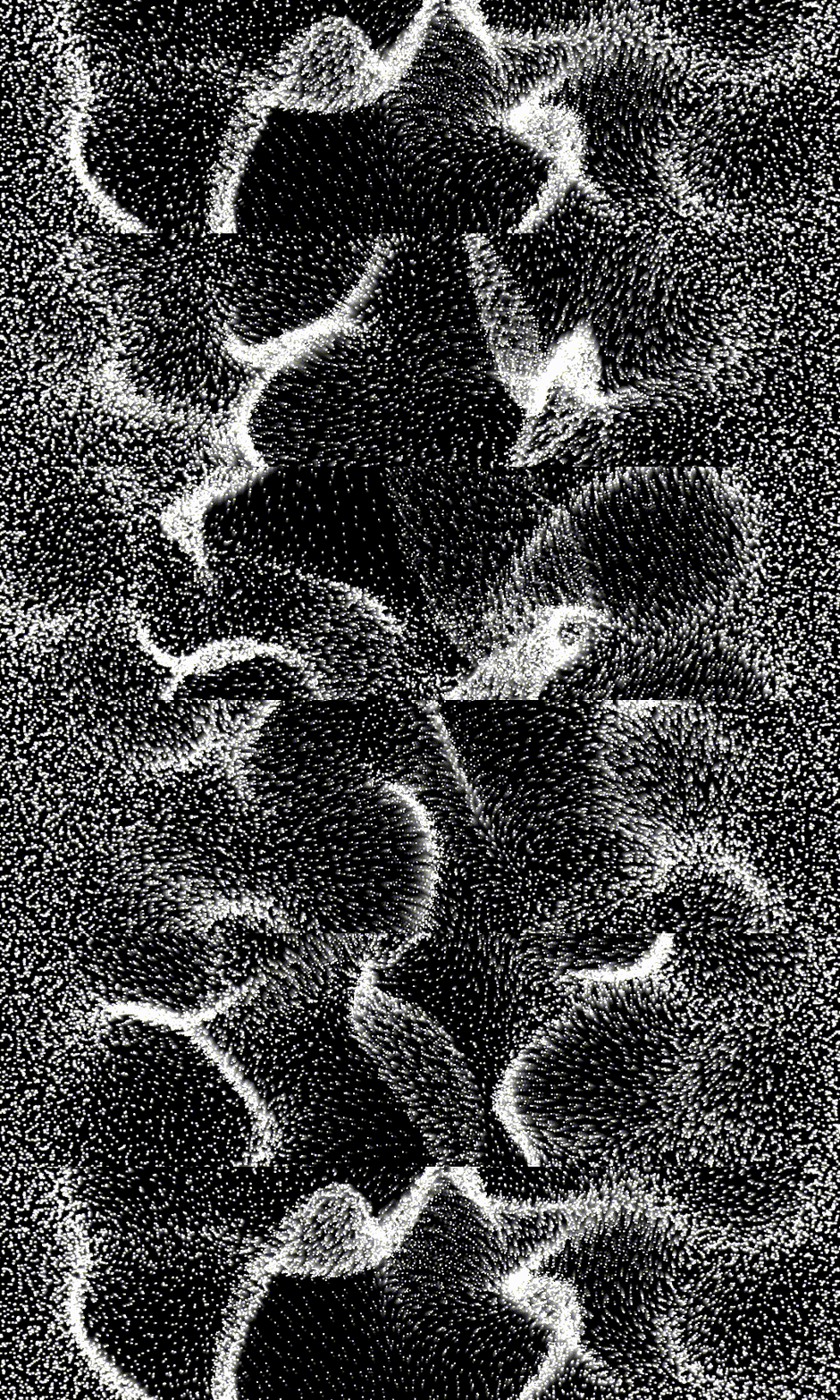
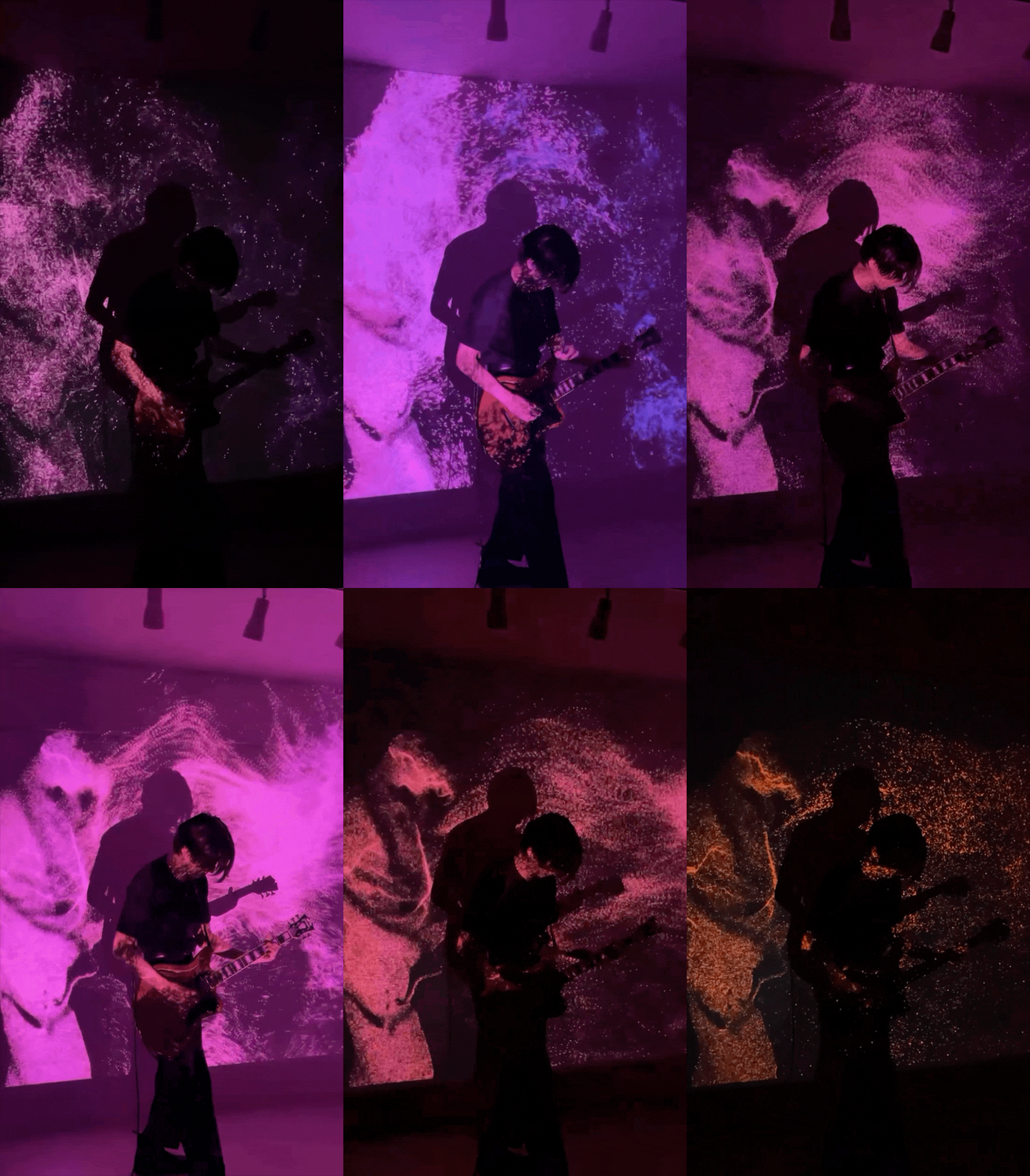
Daichi (Alvie Starr,) Mori is a design technologist who focuses on sound and light. The specific project referenced involves how light movement reacts to the physical properties of a vibrating string. Using real-time audio analysis, Mori maps the amplitude and frequency of the guitar to the displacement and oscillation of a laser beam. I would use this project's sense of brightness and movement in Acapella Waves. The organic movement the projection invokes a feeling of intelligence, one that I hope to recreate in Acapella Waves.
 |  |  |  |